

How Taiwan Footwear Material Suppliers Can Win Global Orders with rCF.
As the footwear industry enters 2026, global manufacturers are facing a new era where regulatory compliance determines market access. With the European Union's Carbon Border Adjustment Mechanism (CBAM) transitioning from its trial phase to full implementation, alongside the comprehensive rollout of the Digital Product Passport (DPP) framework, footwear products are no longer identified solely by brand logos. Instead, they are increasingly defined by transparent carbon footprint data and verified recycled material content.
Scope 3 Carbon Reduction Has Become the New Entry Ticket to Global Supply Chains
International sourcing strategies have fundamentally changed. Cost competitiveness is no longer the primary selection criterion. Today, circularity, traceability, and regulatory compliance have become essential requirements for remaining in global supply chains.
This transformation is largely driven by major international brands' increasingly aggressive Scope 3 greenhouse gas reduction targets, which focus on emissions generated throughout their supply chains.
-
Nike's 2030 Net Zero Roadmap
Nike is accelerating its journey toward achieving net-zero emissions by 2030 while requiring substantial reductions in supplier emissions compared with its baseline year. By 2025, the company had already increased the preferred sustainable material content of key materials—including polyester, leather, and rubber—to 50%. -
Adidas' Material Innovation Strategy
Adidas aims to reduce absolute greenhouse gas emissions across its entire value chain by 30% by 2030. The company continues to invest heavily in sustainable material innovation and has already achieved a milestone of diverting 98% of operational waste from landfills. -
PUMA Vision 2030
PUMA has committed to reducing Scope 3 emissions across its supply chain by 33% by 2030. Beginning in 2026, the company is further strengthening traceability systems for recycled materials throughout its value chain.
For high-performance footwear, virgin carbon fiber delivers exceptional mechanical properties but is also one of the most carbon-intensive materials used in a shoe. Under mounting decarbonization pressure from global brands, finding lower-carbon alternatives has become an urgent industry priority.
From Manufacturing Center to Circular Resource Hub
In response to this sustainability transition, Taiwan's footwear material industry is demonstrating remarkable resilience and innovation.
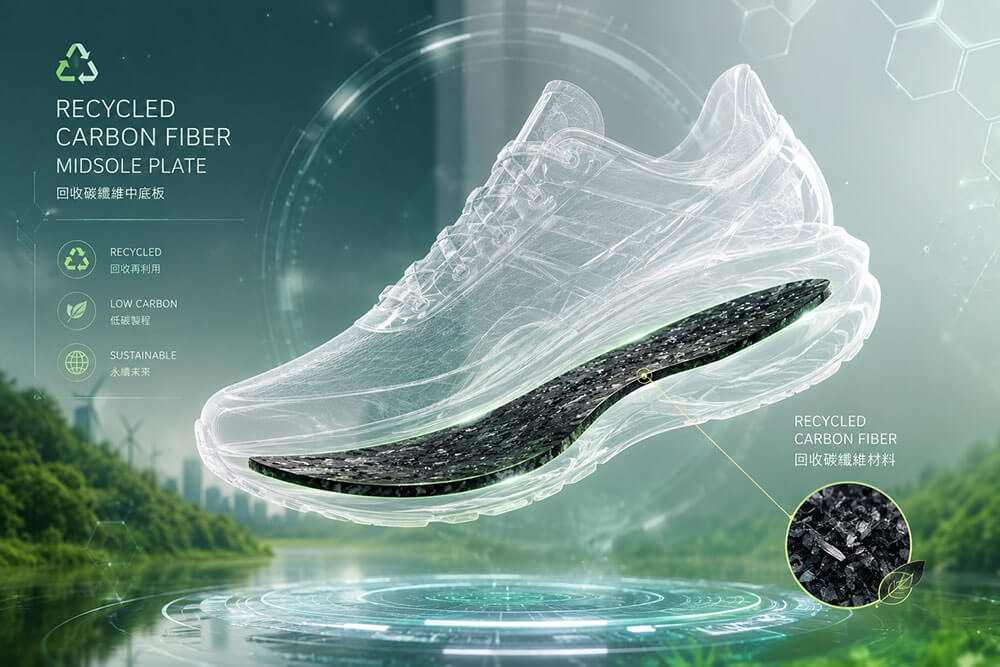
Ying Pao Chia Enterprise has partnered with green technology pioneer Thermolysis Green Energy to introduce the application of recycled carbon fiber (rCF) in critical footwear components, directly addressing the global demand for high-performance recycled materials.
Industry analysts believe this collaboration delivers three strategic advantages:
1. Eliminating Compliance Concerns
By enabling 100% traceable recycled carbon fiber applications, the solution helps brands comply with the EU's 2026 Digital Product Passport requirements, providing transparent material identification and recycled-content disclosure.
2. Achieving the Balance Between Performance and Carbon Reduction
The technology overcomes traditional technical barriers associated with recycled materials in complex footwear applications, maintaining structural strength while significantly reducing product carbon footprints.
3. Building a Green Technology Competitive Advantage
Through the integration of advanced pyrolysis recovery technology and precision manufacturing, Taiwan's supply chain is evolving beyond conventional manufacturing toward becoming a circular resource ecosystem, strengthening its competitiveness and strategic influence in the global footwear market.
According to market research, the global recycled carbon fiber market is projected to grow steadily and approach US$1 billion by 2034. The collaboration between Ying Pao Chia and Thermolysis Green Energy demonstrates a practical pathway for Taiwan's footwear industry to transform environmental challenges into new global business opportunities.
Conclusion: Securing the Next Decade's Supply Chain Position
In the era of sustainability, competitiveness is no longer measured solely by manufacturing capacity but increasingly by an organization's circular resource capability.
For companies seeking to remain competitive in global supply chains, the key lies in proactively collaborating with partners that possess core recycled-material technologies.
Recommended Action
Footwear manufacturers should immediately evaluate opportunities to replace high-carbon, energy-intensive materials with sustainable alternatives. By adopting collaborative models such as the partnership between Ying Pao Chia and Thermolysis , and implementing fully traceable recycled materials, companies can not only comply with evolving EU regulations but also convert ESG challenges into tangible commercial opportunities, ensuring long-term competitiveness in the global footwear supply chain over the next decade. Welcome to contact Ying Pao Chia for further info!