

Functional Plastic Board Industry Trends 2026: Why Composite Plastic Boards Are Replacing Traditional PP & PE Boards
Across footwear, medical devices, industrial equipment, and protective products, manufacturers are under increasing pressure to reduce weight while improving structural performance. This shift is accelerating the evolution of functional plastic boards—from traditional single-material sheets toward engineered composite structures designed for higher performance and greater manufacturing efficiency.
Today, functional plastic boards are expected to deliver not only cost efficiency, but also lightweight construction, structural reliability, and application-specific performance.
As a manufacturer specializing in engineered PP, PE, and composite plastic boards, Ying Pao Chia has observed a growing demand for lightweight, multifunctional material solutions across global industries. This article examines the trends driving this transition and explains how composite board technologies support evolving product requirements.
According to the World Footwear Yearbook 2025 published by APICCAPS, global footwear production exceeded 23 billion pairs annually Meanwhile, Grand View Research projects steady growth in the global engineering plastics market over the next decade, driven by lightweight design, higher-performance materials, and industrial innovation. Together, these trends support rising demand for advanced composite plasticboards.
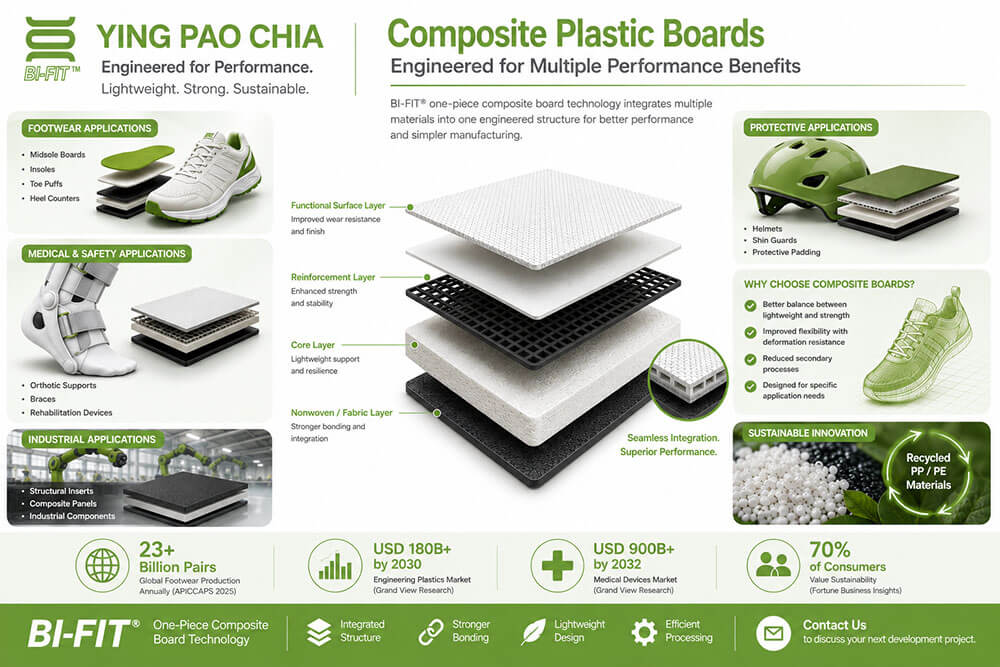
Industry Snapshot
Market Indicator Latest Industry Data
| Global footwear production | 23+ billion pairs annually (Asia ≈90%) |
| Engineering plastics market | USD 180B+ by 2030 |
| Medical Devices Market | USD 900B+ by 2032 |
| Sustainability | 70% of consumers value sustainability |
These indicators reflect growing demand for lightweight, multifunctional materials across industries.
Why Composite Plastic Boards Are Replacing Traditional PP and PE Boards
Although conventional PP and PE boards remain widely used, increasing product complexity is driving manufacturers to seek materials capable of delivering multiple performance characteristics within a single structure.
Traditional PP and PE boards remain valuable for their stable performance and processability. However, as product requirements become more complex, a single-material structure often struggle to provide the necessary balance of strength, weight reduction, and functional performance.
A board may need to stay rigid in one area, flexible in another, hold its shape under repeated stress, and bond efficiently with surrounding materials. Achieving all of that with a single-material structure is becoming more difficult.
This is the main reason the market is shifting. The question is no longer which plastic to choose, but how a board structure can deliver multiple functions at once without adding unnecessary weight or extra assembly complexity.
What Is Driving the Rise of Composite Plastic Boards
Several global manufacturing trends are contributing to the growing adoption of composite plastic boards.
Composite plastic boards combine multiple materials into a single engineered structure, enabling designers to optimize stiffness, flexibility, impact resistance, and bonding performance simultaneously. This shift is being driven by several practical needs:
- Better balance between light weight and strength
- Improved flexibility with greater deformation resistance
- Reduced reliance on secondary lamination or additional adhesive-heavy processes
- Greater flexibility and variations in designing for specific uses
Instead of treating reinforcement as a separate subsequent step, composite boards build performance directly into the material structure.
These trends are not limited to one industry. Similar material requirements are emerging across footwear, medical devices, industrial equipment, and protective products, creating broader opportunities for engineered composite structures.
Applications of Composite Plastic Boards Across Industries
Today's market is not focused on weight reduction alone. Manufacturers want lighter materials that still maintain losing support, durability, and stability. That principle is changing how plastic boards are developed across multiple sectors.
Footwear Applications
In footwear applications, materials often need to combine flexibility, support, rebound, and long-term shape retention. Composite boards help achieve this balance by allowing controlled flexibility while maintaining structural integrity.
Typical applications include:
- Midsole boards
- Insoles
- Toe puffs
- Heel counters
Medical And Safety Applications
The global medical industry continues to expand as healthcare systems demand products that are lighter, more ergonomic, and easier to handle. Material selection increasingly focuses on balancing structural support with user comfort.
Medical and safety applications require materials that are lightweight, dependable, and suitable for consistent extended use. Composite boards help improve support while keeping products more manageable and more comfortable to use.
Typical applications include:
- Orthotic supports
- Medical braces
- Rehabilitation devices
Industrial Applications
Across industrial manufacturing, reducing component weight while maintaining mechanical strength has become an important strategy for improving production efficiency and lowering transportation costs.
Industrial applications increasingly require boards that resist deformation, tolerate tensile stress, and integrate efficiently with surrounding components. Composite boards support this trend by improving structural performance within one board rather than depending on multiple secondary reinforcements.
Typical applications include:
- Structural inserts
- Composite panels
- Industrial components
Protective Applications
In protective equipment, composite boards help reduce weight while maintaining impact absorption and dimensional stability.
Typical applications include:
- Helmets
- Shin guards
- Protective padding
Composite Plastic Board vs Traditional PP & PE Board
The comparison below helps explain why composite plastic boards are gaining attention in the global market.
| Property | Traditional PP / PE Board | Composite Plastic Board |
| Material Structure | Single material | Integrated multi-material structure |
| Weight And Strength Balance | Moderate | More optimized |
| Structural Reinforcement | Limited by base resin | Improved through composite design |
| Flexibility Control | Less precise | Easier to engineer |
| Adhesion And Lamination | May need extra treatment | Can be enhanced through material integration |
| Processing Efficiency | More secondary steps may be needed | Can simplify downstream processing |
| Sustainability Potential | Depends on resin content | Strong when recycled materials are integrated |
This trend does not mean PP and PE boards are disappearing. It means composite solutions are becoming the ideal choice when applications demand more than a standard sheet can provide.
Why Composite Boards Are Becoming a New Industry Standard
Composite plastic boards are gaining importance because they help manufacturers improve structural performance, reduce weight, and simplify downstream production within a single engineered structure. As product design becomes more performance-driven, material selection is shifting from single-material adequacy to integrated structural solutions.
Ying Pao Chia’s Capabilities In Composite Board Development
Unlike conventional sheet manufacturers, Ying Pao Chia focuses on engineering composite board structures that integrate material science, process optimization, and application-specific design into a single manufacturing solution.
Our experience in composite plastic board development is closely connected to the same market demands. To support these changing demands, we focus on capabilities that directly match functional composite applications:
- Proprietary BI-FIT technology for one-piece composite board development
- Integration of PPor PEwith fabrics and other materials to improve adhesion, durability, and overall board performance
- Engineered dual-hardness and dual-density structures that enable localized flexibility without sacrificing structural support.
- OEM and ODM development support, from material selection and 3D drawing to mold development, sampling, testing, and mass production
- Sustainability-oriented production, including GRS 4.0 alignment and the use of high percentages of recycled PP and PE materials
These strengths allow us to respond more effectively to applications that require lightweight structures with higher performance expectations.
The Future of Functional Plastic Boards
The future of functional plastic boards will be shaped by integrated structures rather than single-material solutions. As manufacturers continue to pursue lightweight design, durability, and lower environmental impact, composite plastic boards are expected to play a growing role across footwear, medical, industrial, and protective applications.
Looking for a lightweight, high-performance composite board solution?
From concept development to mass production, Ying Pao Chia partners with global manufacturers to develop application-specific composite board solutions that balance performance, manufacturability, and sustainability. Contact us to discuss your next development project.
Frequently Asked Questions
Q1. What is a composite plastic board?
A composite plastic board combines multiple materials into a single engineered structure to improve strength, flexibility, durability, and processing efficiency.
Q2. What is the difference between PP boards and composite plastic boards?
Traditional PP boards use a single resin, while composite boards integrate multiple materials to achieve broader performance characteristics.
Q3. Which industries use composite plastic boards?
Composite plastic boards are widely used in footwear, medical devices, industrial equipment, and protective products.
Q4. Can composite boards incorporate recycled materials?
Yes. Depending on application requirements, composite boards can integrate recycled PP or PE materials to support sustainability objectives.
Reference
■ World Footwear Yearbook 2025 (APICCAPS)(23+ billion pairs)
■ Grand View Research(Engineering Plastics Market)
■ Fortune Business Insights
■ MarketsandMarkets
■ Precedence Research